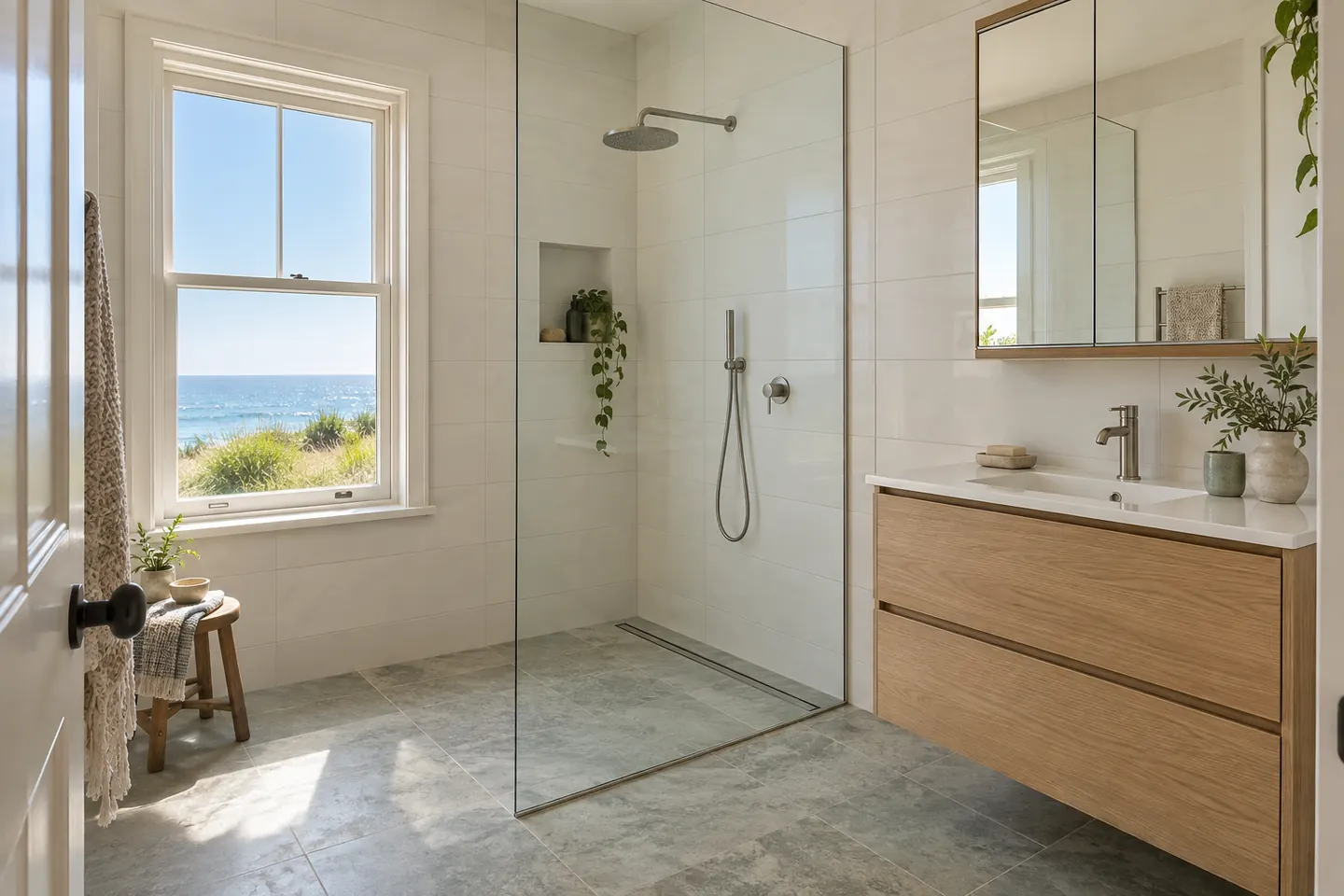
When a full renovation is the right answer
A tired bathroom is not automatically a demolition job. If the shower holds water, the floor is solid and the tiles ring rather than sound hollow, new tapware, a vanity, better light, a regrout and a proper fan will get you most of the way for far less.
A full renovation is the right call when two or three of these are true:
- Water is going where it should not — a soft floor near the shower, swollen skirting, a stain on the ceiling below
- Tiles are drummy or cracking, particularly across the floor
- The pipework is original, with poor pressure or rust marks in the basin
- Mould returns no matter what you do to it
- The layout fights you — a door that opens onto the toilet, a shower you cannot turn around in
- There is fibro in the room and you would rather it was gone
The stages
1 · Test before anything is disturbed
If the house or the bathroom predates about 1990, suspect sheeting is sampled and sent away. A great many cottages and post-war houses through Kiama, Bombo and Gerringong have fibro in the bathroom walls, the ceiling or under the vinyl. A positive result means licensed removal and a clearance certificate before the other trades return. It is a known cost, not a disaster, as long as you find out early.
2 · Strip out
Tiles, mortar bed, bath, base, vanity, pan, screen and linings. Two days of noise, and the first time anybody can see the truth about the room.
3 · Repair what is revealed
Joists that have been wet under the old shower, a bottom plate eaten by termites, a stud wall bowed out of plumb. Photographed, discussed, priced against the allowance in the quote and then fixed properly. In a coastal cottage this stage is the difference between a renovation and a cover-up.
4 · Rough-in
New supply lines and waste, and new circuits for lighting, the fan and any heating. Old galvanised pipe is replaced while the wall is open. Noggings and solid backing go in wherever a rail, a seat, a shelf or a heavy mirror will later be fixed, whether or not it is being fitted now.
5 · Sheet and screed
Wet-area board to the walls, and a screed to the floor set with a genuine fall to the waste. Falls get checked with a level and a bucket of water, not by eye.
6 · Waterproof, then wait
Membrane to the floor, up the shower walls, into every corner and around every penetration. Then cure time, which the weather sets. See waterproofing and tiling for what that involves and why nobody should rush it.
7 · Tile
Set-out planned before the first tile: full tiles where the eye lands, cuts where it does not, and the niche aligned to a grout joint rather than floating in the middle of a tile. If you are considering plank formats, the timber-look tiles guide covers how they behave.
8 · Fit-off and handover
Vanity, toilet, tapware, screen, mirror, lights, fan, hooks and shelves. Then a clean, a walk-through, the waterproofing certificate and the warranty paperwork.
Designing it for this coastline
Ventilation is not an accessory. A fan sized to the room, ducted to outside air and running on after the light goes off. Ducting into the roof space just moves the moisture somewhere it can do more damage.
Specify for salt. Better base metals in tapware, stainless fixings, minimal exposed hardware on the screen, a coated or plastic fan grille. It is a small line on the quote and it changes how the room looks in year eight.
Plan for low winter light. South-facing cottage bathrooms get very little daylight in winter. Lighter tiles, clear glass rather than frosted, and a light at the mirror rather than only in the ceiling.
Think fifteen years ahead. A level-entry shower, solid backing in the walls and a non-slip floor cost almost nothing now and a great deal later. More on the accessible bathrooms page.
Storage. Drawers rather than a cupboard, a mirror cabinet, a niche in the shower wall. Most bathrooms of this era were built with nowhere to put anything.
Timber floor or slab?
Timber on piers is common in cottages through Kiama, Bombo, Gerringong and the valley. It gives flexibility, because drainage can be reworked from underneath, and it lets you drop the framing for a level-entry shower. It also demands more care at the waterproofing stage, because timber moves with moisture.
Slab on ground is the norm in brick veneer from the seventies onward and in townhouses. It is forgiving to waterproof and unforgiving to alter: moving a waste means cutting concrete.
What the quote should spell out
- Asbestos testing, and how removal would be priced if it is positive
- A stated allowance for concealed rot and structural repair, with a variation method
- Which pipework is replaced and how far back
- Fittings by brand and model, and the tile allowance per square metre
- Waterproofing method, standard and cure time
- Fan model, duct size and where it discharges
- Site protection, skip placement and waste removal
- The program in working days
Paying for it
In NSW the deposit on residential building work is capped at 10 per cent, and above the NSW threshold for home building compensation cover that cover must be in place before a deposit is requested. After that, payments should follow completed stages.
Renovation work is carried out in partnership with Coastal Renovation Group, a licensed NSW builder. Licence and insurance details are provided on request.
The cost page has the guide tiers and how the job runs has the timing, day by day.
Call 02 4214 4021 or send the room details through.
Other bathroom work
- Ensuites
- Tacked-on ensuites and old sleepout bathrooms reworked into a second bathroom that earns its space.
- Small Bathrooms
- Cottage and townhouse bathrooms where a metre of floor is the whole design problem.
- Accessible Bathrooms
- Step-free showers, seats, blocked-out walls and non-slip floors for people who'd rather not move house.
- Laundry Renovations
- Back-of-house laundries sorted out properly — sand, wet towels, dog bowls and all.
- Waterproofing & Tiling
- Membrane, falls and set-out: the invisible half of the job that decides how long the visible half lasts.
- Rental & Holiday-Let Bathrooms
- Hard-wearing bathrooms for long-term rentals and short-stay houses, programmed to fit between bookings.
Questions people ask before they commit
Does the whole room have to come out?
Not always, and a good measure will tell you when it does not. A full renovation earns its cost when water is escaping the shower, the floor framing is suspect, the pipework is original or the layout genuinely does not work. If none of those are true, a refresh may be the better spend.
How long does a full renovation take?
Around three and a half to five weeks on site. Slab-on-ground with nothing moving is quicker; a cottage with asbestos removal, floor repairs and new pipework is longer, and a humid fortnight adds days to the membrane cure.
Can the new tiles just go over the old ones?
It happens, and in an older bathroom it is usually a mistake. You cannot inspect or repair the membrane underneath, the floor level rises at the doorway and the waste, and if the original bed lets go the new tiles go with it.
Can the shower or toilet be moved?
On a timber floor with access underneath, often without much drama. On a slab it means cutting concrete, which costs real money, so it is worth testing whether the move actually improves the room before paying for it.