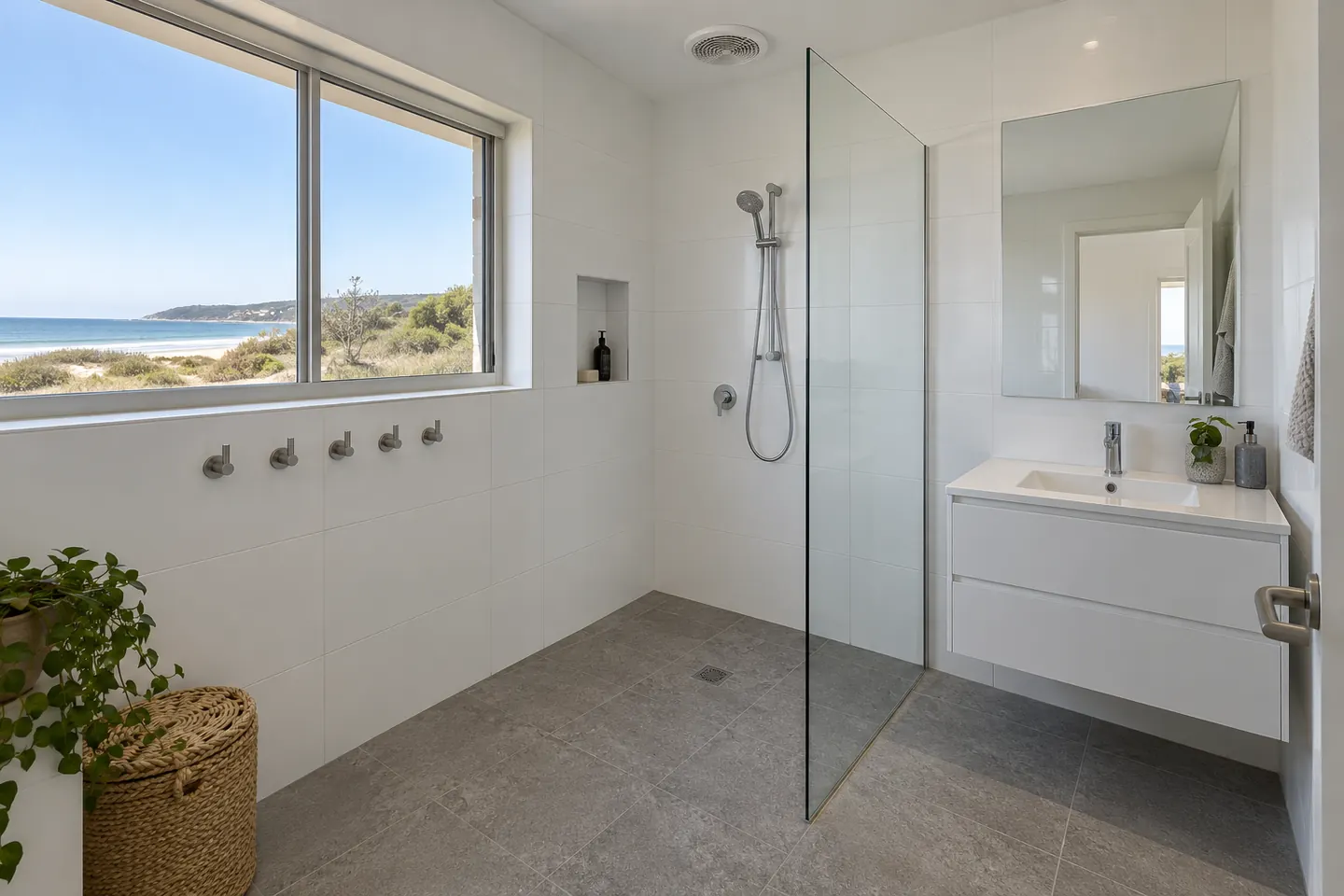
Two different briefs
Short-stay and long-term rental bathrooms get grouped together because they are both investment properties, but the briefs are not the same.
A holiday house is judged on photographs and reviews, used intensely in bursts, cleaned by somebody on a two-hour changeover, and completely unavailable while the work happens. Bookings run the program.
A long-term rental is judged on compliance, maintenance calls and how it presents at an inspection. Work is programmed around a tenancy, not a booking, and the goal is a bathroom that generates no phone calls for a decade.
Both want the same underlying thing: a room with very little in it that can break.
The durability rules
Fewer moving parts. A fixed glass panel instead of a hinged or sliding door removes rollers, hinges, catches and the seal along the bottom — all of which fail, and all of which fail faster in salt air. It also makes the shower easier to clean, which matters on a changeover.
Wall-hung everything. A wall-hung vanity keeps its toe out of standing water and lets a mop go straight under it. A wall-hung or fully sealed pan surround is the same idea.
Hooks rather than rails. Rails get hung off, and a rail pulled out of plasterboard takes a chunk of wall with it. Hooks in solid backing hold a towel, dry it just as well, and cost less.
Solid backing behind everything fixed to a wall. Towel hooks, the toilet roll holder, the shower rail, the mirror. In a property where guests will lean on and pull at things, this is not optional.
A solid top, not a laminate one. The vanity top takes hair dye, sunscreen, hot styling tools and spilled everything. Sealed, non-porous, and with an edge that will not chip.
Lever tapware and a single mixer. Fewer parts, easier for guests who have never seen your bathroom before, and no three-piece set with two washers to replace.
Tapware specified for the coast. A holiday house near the water goes through a lot of thin electroplated finish very fast. Better base metals and stainless fixings are a false economy to skip.
Detail that makes a changeover fast
Cleaners have a fixed amount of time and a lot of rooms.
- Mid-tone floor tiles with matching grout. Shows sand and hair less, and a mop over it reads as clean.
- Epoxy or high-performance grout in the shower. Resists staining and mould, so scrubbing does not become part of every changeover.
- Full-height tiling in the shower. Nothing to repaint above the screen.
- A minimum of ledges. Every horizontal surface is something to wipe. A single recessed niche beats three glass shelves.
- A strong fan wired to the light, with a run-on timer. Guests will not turn a fan on and will not leave a window open. The room has to clear itself.
- A floor waste. For the day somebody leaves the shower running, and for hosing the room out at the end of the season.
- Nothing precious. A beautiful vessel basin on a timber benchtop is a bad idea in a house that sleeps twelve.
Sand, and where it stops
Beach houses through Gerroa, Werri Beach, Kiama Downs and Bombo have one problem above all others: sand comes inside, and it goes into the shower waste, the grout and the drain.
The fix is to stop it at the door. An outdoor rinse point, or ideally a proper outdoor shower with its own drain, a hanging rail under cover for towels and wetsuits, and a laundry set up as a wet zone with a floor waste. Guests will use it if it exists and is obvious, and every kilogram of sand it catches is sand not going through the bathroom.
Programming it around the calendar
This is the part that gets underestimated.
- Name the immovable date. The first booking you will not cancel.
- Work backwards from it, with the membrane cure and grout cure at their realistic length, not their optimistic one.
- Add contingency days. A wet fortnight, a lab result, a special-order screen.
- Lock every selection before the strip-out. Late selections are the single biggest cause of overrun, and in a booked property an overrun costs real revenue.
- Stage multiple bathrooms rather than doing them together, if keeping the property lettable matters more than the saving.
- Order long-lead items first. A made-to-measure screen or an interstate tile can be weeks.
The stage-by-stage timing is on how the job runs.
Long-term rentals
For a tenanted property the priorities shift slightly: compliance and the absence of maintenance calls. Ventilation that works, a shower that does not leak into the frame, a floor with falls that actually drain, hot water that is delivered at a safe temperature, and no surface that will grow mould while the tenant insists they are cleaning it.
Landlord obligations on minimum standards and repairs sit with NSW Fair Trading and they change, so confirm current requirements there rather than relying on a page like this one. What a renovation can do is remove the causes of most complaints.
What it costs
A tight-scope rental bathroom generally sits in the lower or middle guide tier; a full holiday-house bathroom with better fittings sits in the middle. The cost page sets out the tiers and the factors that move a job between them. If the room needs stripping back, see full bathroom renovations.
Renovation work is carried out in partnership with Coastal Renovation Group, a licensed NSW builder. Licence and insurance details are provided on request.
Call 02 4214 4021 or send the room details through.
Other bathroom work
- Full Bathroom Renovations
- Weatherboard, fibro and brick-veneer bathrooms taken back to the frame and rebuilt to last on a salty coastline.
- Ensuites
- Tacked-on ensuites and old sleepout bathrooms reworked into a second bathroom that earns its space.
- Small Bathrooms
- Cottage and townhouse bathrooms where a metre of floor is the whole design problem.
- Accessible Bathrooms
- Step-free showers, seats, blocked-out walls and non-slip floors for people who'd rather not move house.
- Laundry Renovations
- Back-of-house laundries sorted out properly — sand, wet towels, dog bowls and all.
- Waterproofing & Tiling
- Membrane, falls and set-out: the invisible half of the job that decides how long the visible half lasts.
Questions people ask before they commit
When is the best time of year to do a holiday-let bathroom?
Between about May and August, when bookings thin out on this coast. Give us the first booking you cannot move and the program is written backwards from it with spare days built in, rather than assumed away.
Can the house keep taking bookings during the work?
If there are two bathrooms, staging them one at a time often keeps the property lettable, with the listing updated to say one bathroom is available. With a single bathroom, no — and it is better to block the dates than to gamble on a membrane cure.
What fails first in a short-stay bathroom?
Moving parts and soft edges. Hinged screen doors, roller assemblies, towel rails pulled off the wall, laminate vanity toes swollen from standing water, and silicone at the floor junction. A fit-out with fewer moving parts and harder edges lasts years longer.
Is a holiday-let bathroom cheaper than a family one?
Not if it is done properly. The scope is often tighter and the finishes plainer, but durability costs money and it is the part worth spending on. The cost page sets out the guide tiers and what moves a job within them.