What a laundry has to cope with down here
Ask what goes through a laundry in a house near Werri Beach or on a Jamberoo farm and the list gets long: sand, salt, wet towels, wetsuits, boardies, school uniforms, work clothes with mud on them, a dog that has been in the creek, and in summer, the laundry from a house that sleeps ten.
Most laundries in this area were built for one washing machine and a broom. They have a concrete tub on legs, a single cupboard, no bench, a wall-mounted dryer that vents into the room, and a floor that slopes the wrong way.
The laundries we see
Cottage laundries. Often on a back verandah or in a lean-to, sometimes barely enclosed, with a concrete or fibro floor and a tub plumbed as an afterthought. Fibro linings need testing before anything is disturbed.
Brick veneer laundries. A narrow room off the kitchen or between the kitchen and the back door, with a trough, a single overhead cupboard and an external door. The bones are usually fine and the layout is usually poor.
Townhouse and duplex laundries. A cupboard, sometimes stacked above living space, sometimes in the garage. Waterproofing and the floor waste matter more here than anywhere.
Farmhouse laundries. Big rooms that do real work, often with a separate boot area, tank water and a pressure pump, and frequently the room where the hot water system lives.
A layout that earns its keep
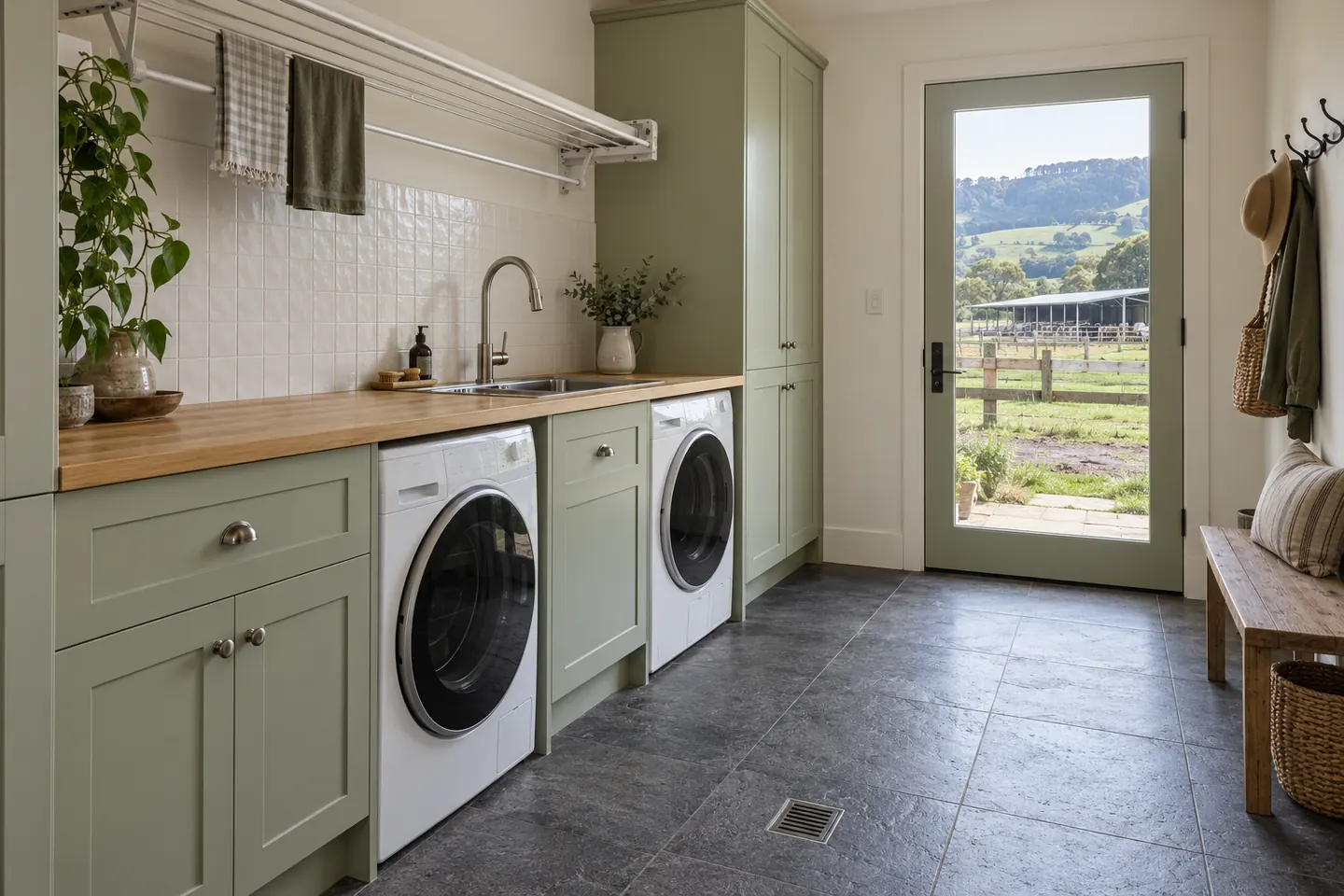
Bench over the machines. Front loaders side by side under a continuous benchtop is the single biggest upgrade available. Somewhere to fold means the ironing does not migrate to the dining table.
A deep tub with a decent mixer. Not a bar sink. A laundry tub needs to take a bucket, and a gooseneck or pull-out mixer makes rinsing sand and hosing out a wetsuit possible.
A tall cupboard. For the broom, the vacuum, the mop and the ironing board. Every laundry needs one and almost none have one.
Hanging space inside. A rail or a drop-down line for the days when the washing cannot go out, which on this coast is a lot of days. A pull-out rail over the tub is the cheapest version.
A proper floor waste. With the floor actually falling to it. It turns a flood from a disaster into a mop-up, and it lets you hose the room out after the beach.
Bin and basket space. Built in, in the cabinetry, rather than sitting on the floor in the walkway.
Sand, salt and wetsuits
This is where a coastal laundry differs from any other room in the house.
A rinse point outside the back door. A tap and a hose, or better, a proper outdoor shower with a drain, so sand and salt stop at the door instead of coming through it. This is the single highest-value thing you can add to a beach house, and the guide covers siting, plumbing, drainage and screening in full.
A hanging rail outside, under cover. Wetsuits and towels drip, and they drip for hours.
A dedicated wet zone inside. Hooks at adult and child height, a tiled or fully sealed section of wall, and a floor that can be hosed.
Hardware chosen for salt air. A laundry with an external door is one of the more exposed rooms in the house. Stainless fixings, and tapware with better base metals, last considerably longer.
Flooring that forgives sand. Mid-tone textured porcelain with a grout colour that is not white. Pale polished tile in a beach house laundry looks superb for about a week.
Mudroom and boot area
Farmhouses out toward Jamberoo and the valley roads often have the space to do this properly, and it is worth the room: a bench to sit on to pull boots off, hooks above it, a shelf under it, a tiled floor with a waste, and a door through to the laundry proper. Keeping the mud in one room is a strategy, not a luxury.
Ventilation and the dryer
A laundry generates as much moisture as a bathroom and usually has worse ventilation. Whichever way you go:
- A vented dryer must duct to outside, not into the room and not into the roof space
- A heat pump or condenser dryer needs no duct and suits a small or internal laundry, though it needs the door open or a fan to shed the heat
- An exhaust fan in an internal laundry, ducted outside, on a timer
- Insulate the duct where it crosses a cold roof space, or condensation forms inside it and runs back down
Waterproofing and the floor
A laundry is a wet area and the membrane detail is not optional, particularly in a townhouse above another dwelling or a laundry above living space. The membrane runs under the tiles, up behind the tub and the machine wall, around the floor waste and around every pipe penetration. It is the same standard of work as a bathroom and the same cure time, which is set out on the waterproofing and tiling page.
Doing it with the bathroom
If the laundry backs onto or sits near the bathroom, doing both together is the cheaper path by a clear margin — one mobilisation, one membrane cure, one tiler, one skip. See full bathroom renovations for what that involves, and the cost page for the guide tiers. Most laundries on their own sit in the lower tier.
Renovation work is carried out in partnership with Coastal Renovation Group, a licensed NSW builder. Licence and insurance details are provided on request.
Call 02 4214 4021 or send the room details through.
Other bathroom work
- Full Bathroom Renovations
- Weatherboard, fibro and brick-veneer bathrooms taken back to the frame and rebuilt to last on a salty coastline.
- Ensuites
- Tacked-on ensuites and old sleepout bathrooms reworked into a second bathroom that earns its space.
- Small Bathrooms
- Cottage and townhouse bathrooms where a metre of floor is the whole design problem.
- Accessible Bathrooms
- Step-free showers, seats, blocked-out walls and non-slip floors for people who'd rather not move house.
- Waterproofing & Tiling
- Membrane, falls and set-out: the invisible half of the job that decides how long the visible half lasts.
- Rental & Holiday-Let Bathrooms
- Hard-wearing bathrooms for long-term rentals and short-stay houses, programmed to fit between bookings.
Questions people ask before they commit
Is it cheaper to do the laundry with the bathroom?
Nearly always, if the two rooms are close together. The same trades attend once, the waterproofing is done in one pour and one cure, and there is one skip instead of two. Doing them a year apart can cost a third more for the same work.
Does a laundry have to be waterproofed?
The wet areas do, and the details matter. A laundry with a tub, a washing machine and a floor waste is a wet area, and a laundry above a living space or in a townhouse above another dwelling is exactly where you want the membrane done properly.
Where should a dryer vent to?
Outside, if it is a vented dryer — into the room or the roof space is how you get mould on a laundry ceiling. A heat pump or condenser dryer does not need a duct at all and suits a small internal laundry better.
Can a laundry be moved or combined with the bathroom?
Sometimes, and in a small cottage a combined room can be the best use of the space. It depends on drainage, venting and whether the floor plan gives you anywhere better. It is worth pricing both options at the measure.