Why this page exists
Every failed bathroom we get called about failed at one of three points: the membrane, the falls, or a junction detail. Not the tile. Not the tapware. The parts that are covered up on about day twelve and never seen again.
So this is the page about them, at more length than most people want, because the alternative is finding out in four years.
The membrane
What it does
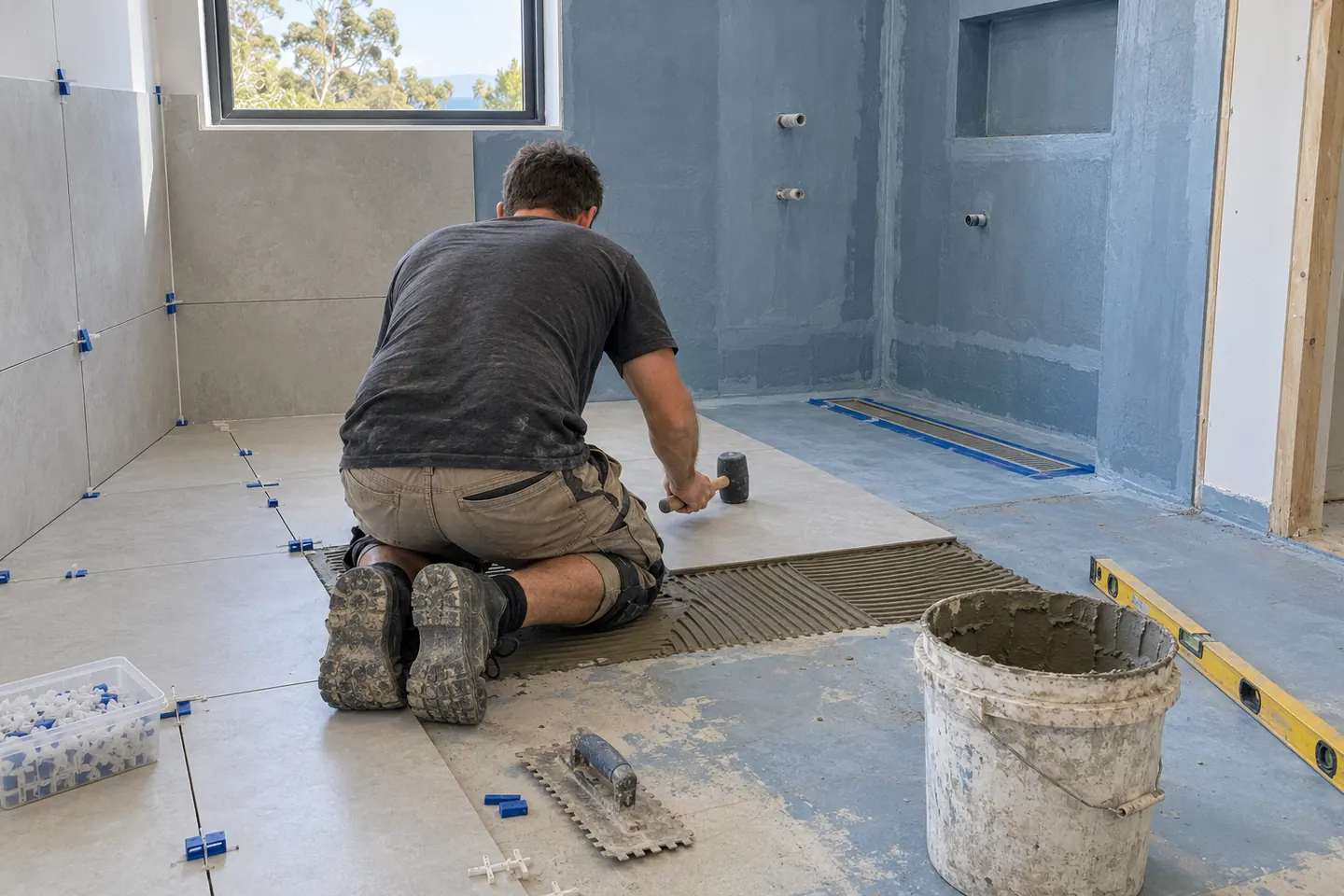
The membrane is a continuous waterproof layer applied to the substrate before tiles go on. Tiles and grout are not waterproof — grout is porous and a tiled surface moves — so the membrane is the actual barrier. Everything above it is a wearing surface.
Where it goes
The whole floor. The shower walls to the required height. Up the walls a set distance elsewhere. Around every penetration: the waste, tap bodies, the shower rail, a wall-hung pan, the vanity fixings. Into every internal corner and over every hob. And crucially, bonded to itself as one continuous layer with no unsealed lap.
Where it fails
At the junctions. Floor to wall, wall to wall, and around the waste. These are where the substrate moves, and they need a bond breaker or a proprietary corner detail so the membrane can accommodate movement instead of tearing.
At penetrations. Every pipe through the membrane is a hole that somebody has to seal properly. This is where hurried work shows up first.
At the wrong film thickness. Membranes are specified in coats and thickness. Two thin coats rushed on in a day are not the same as the specified build, and you cannot tell by looking.
By tiling too early. The most common shortcut, and the most invisible.
Cure time on this coast
Humidity extends cure time. The escarpment sits close behind this coastline and holds moisture in the air, and a wet fortnight in autumn can add days to a membrane that would have been ready in a drier week. A program that has no slack in it is a program that pressures somebody into tiling early. Ours builds the slack in, which is why how the job runs quotes a range rather than a date.
The screed and the falls
Waterproofing keeps water out of the building. Falls get water out of the room. They are different jobs and both have to be right.
A screed is laid over the membrane or under it depending on the system, set so the floor falls consistently to the waste with no flat spots and no low point anywhere else. In a level-entry shower, which is what most people now want, the fall is doing more work because there is no hob holding water back. It gets checked with a level, and then with water.
Signs the falls were wrong on the last renovation:
- A puddle that sits in the same spot after every shower
- Water tracking out past the screen onto the main floor
- A grout line that is permanently darker than the ones around it
- Efflorescence — white powdery deposit — at the base of a wall
Tiling
Set-out comes before the first tile
Set-out is the plan: where the full tiles land, where the cuts go, how the wall courses line up with the floor, and where the niche sits relative to a grout joint. Done first, on paper and then on the wall in pencil, it is the difference between a room that looks resolved and one that looks like it was tiled from whichever corner was closest.
The rules of thumb: full tiles where the eye lands first, cuts in the corners and behind fixtures, no sliver cuts, and never a cut narrower than about a third of a tile if it can be avoided.
Tile choice and how it behaves
Large format looks calm and needs a flat substrate — a wall out of plumb shows immediately, and lippage between tiles is more visible the bigger they are.
Small format and mosaic give more grout line, which means more grip. That makes them a good choice on a shower floor even where the rest of the room is something else.
Plank formats have their own set-out logic and their own quirks, because long thin tiles have a slight bow along their length. They are covered in detail in the timber-look tiles guide.
Slip rating matters on a shower floor and is a property of the tile, not of the installation. Ask for it.
Colour and sand. In a house that gets beach sand walked through it, a mid-tone textured floor with a grout colour to match will look clean between cleans. A pale polished floor will not.
Grout
Grout choice is where a lot of regret lives. Cement-based grout is porous and stains. High-performance and epoxy grouts resist staining and mould far better, cost more to buy and take longer to install, and in a shower they are worth it. Mid-tone colours forgive far more than white or charcoal, both of which show everything, in opposite directions.
Silicone, not grout, at the movement joints
Internal corners and the floor-to-wall junction move. They get a flexible sealant, not grout. Grout in those joints cracks, which is the first thing most people notice going wrong, and it is a sign the room was finished quickly.
What to ask for
- The membrane product and the standard it is installed to
- The number of coats and the cure time allowed in the program
- How junctions, hobs and penetrations are detailed
- Where the falls run and how they are verified
- The set-out, agreed before tiling starts
- Grout type and colour, and where silicone is used instead
- The slip rating of the shower floor tile
- The certificate and product documentation at handover
As part of a whole renovation
This stage sits inside a larger job. See full bathroom renovations for the whole sequence and the cost page for the guide tiers. For a bathroom that is leaking but otherwise sound, the measure will tell you honestly whether a repair is realistic or whether the floor needs to come up.
Renovation work is carried out in partnership with Coastal Renovation Group, a licensed NSW builder. Licence and insurance details are provided on request.
Call 02 4214 4021 or send the room details through.
Other bathroom work
- Full Bathroom Renovations
- Weatherboard, fibro and brick-veneer bathrooms taken back to the frame and rebuilt to last on a salty coastline.
- Ensuites
- Tacked-on ensuites and old sleepout bathrooms reworked into a second bathroom that earns its space.
- Small Bathrooms
- Cottage and townhouse bathrooms where a metre of floor is the whole design problem.
- Accessible Bathrooms
- Step-free showers, seats, blocked-out walls and non-slip floors for people who'd rather not move house.
- Laundry Renovations
- Back-of-house laundries sorted out properly — sand, wet towels, dog bowls and all.
- Rental & Holiday-Let Bathrooms
- Hard-wearing bathrooms for long-term rentals and short-stay houses, programmed to fit between bookings.
Questions people ask before they commit
How long does the membrane need before tiling?
It depends on the product and on the weather. Manufacturers specify a cure time at a given temperature and humidity, and a humid week on this coast stretches it. A membrane tiled over early is a membrane that has not reached its properties, and nothing about the finished room will show you that until it leaks.
Should waterproofing go over the whole bathroom floor?
In practice, yes, and it is what any careful installer does. The whole floor, the shower walls to height, all the junctions, hobs and penetrations, and up behind the vanity. The cost difference over the shower alone is trivial next to the cost of being wrong.
Can waterproofing be repaired without removing the tiles?
Surface-applied products exist and they sometimes buy a few years, particularly where the leak is a failed junction or a cracked grout line. They cannot fix a membrane that was never there or a floor that has no fall. If a shower is leaking into the frame, the honest answer is usually to take it up.
Do I get paperwork for it?
You should, and you should keep it. The waterproofing details, the product used and the installer's certification are part of handover, along with any warranty documents. If a bathroom is sold or an insurer asks, that paperwork is what you produce.